Owls
A Deep History of Owls in Magic, Myth, and Witchcraft
They see in the dark. They move in silence. They have been watching us for a very long time. There is something about an owl that stops you. Maybe you've heard one at night — that hollow, resonant call drifting through the dark — and felt something shift in your chest. Maybe you've been lucky enough to see one, turning that impossible neck to look directly at you with eyes that seem to hold more than an animal should. Whatever the encounter, it tends to feel like something more than coincidence. Like being noticed by something ancient.
You are not imagining it. Humans have been feeling exactly that way about owls for as long as we have been keeping records — and in every culture that has left those records, the owl occupies a place of profound symbolic and spiritual significance. Messenger of the gods. Companion of witches. Herald of death. Keeper of wisdom. Guide through darkness. The owl has worn all of these meanings, and the weight of them has only accumulated over millennia.
Athena's Owl: Wisdom, Knowledge, and the Inner Light
The most enduring association between owls and wisdom in Western culture comes from ancient Greece, where the owl was the sacred animal of Athena — goddess of wisdom, craft, strategy, and civilization itself. The little owl (Athena noctua, still named for the goddess) was so associated with Athens, Athena's city, that it appeared on Athenian coins. To see an owl before a battle was considered a sign of Athena's favor and predicted victory.
But why wisdom? The Greeks observed what we still observe: owls see in the dark. They navigate by night with a confidence and precision that daylight-bound creatures cannot match. To the ancient mind, this was a perfect metaphor for the kind of intelligence Athena represented — not just the accumulation of facts, but the ability to see clearly when others are blind, to find truth in obscurity, to illuminate what darkness conceals.
The phrase "the owl of Minerva flies at dusk" — Minerva being Athena's Roman counterpart — became a philosophical saying meaning that wisdom only arrives in retrospect, after events have unfolded. We understand things in hindsight that we couldn't see in the moment. The owl, flying at dusk, sees what the daylight missed.
For anyone working with wisdom energy in their practice — seeking clarity, studying, making difficult decisions, or doing any kind of illuminating shadow work — the owl is a powerful ally to call upon.
🦉 The Owl Moon print captures that wisdom-and-darkness energy perfectly — an owl in its element, the moon at its back, seeing everything.
Hecate's Owl: Magic, the Underworld, and the Crossroads
Athena's owl was the owl of intellect. Hecate's owl was something wilder and older. Hecate — goddess of witchcraft, crossroads, the moon, and the liminal spaces between worlds — counted the owl among her sacred animals alongside the black dog and the serpent. Her owl was specifically the screech owl, whose eerie, almost human-sounding cry was considered an omen in the ancient world.
In Roman tradition, the screech owl's call near a house was an omen of death — and several famous deaths in Roman history were said to have been predicted by an owl's cry. Julius Caesar, Augustus, and Agrippa all reportedly had owls appear as omens before their deaths. The Latin word for screech owl, strix, became synonymous with witch — a strix was a witch who could transform into an owl, fly by night, and drink blood. The word survives today in Romanian and Italian as a term for witch.
This is the shadow side of owl symbolism — not wisdom, but prophecy of endings. Death, in most pagan and magical traditions, is not purely negative. It is transformation. The owl as death omen is the owl as messenger from the other side of the veil, announcing that a transition is coming. In this sense the owl serves Hecate's function: standing at the crossroads, holding a torch, helping the traveler navigate what lies between.
Modern witches who work with Hecate — in shadow work, ancestral communication, transitions and endings, or the dark moon — often find the owl appearing as a symbol or even a physical presence at significant moments.
🌙 The Triple Moon Owl doormat places that liminal, Hecate-adjacent energy right at your threshold — the owl guarding the crossing between outside world and sacred home.
The Barn Owl: Ghost Bird of the Old World
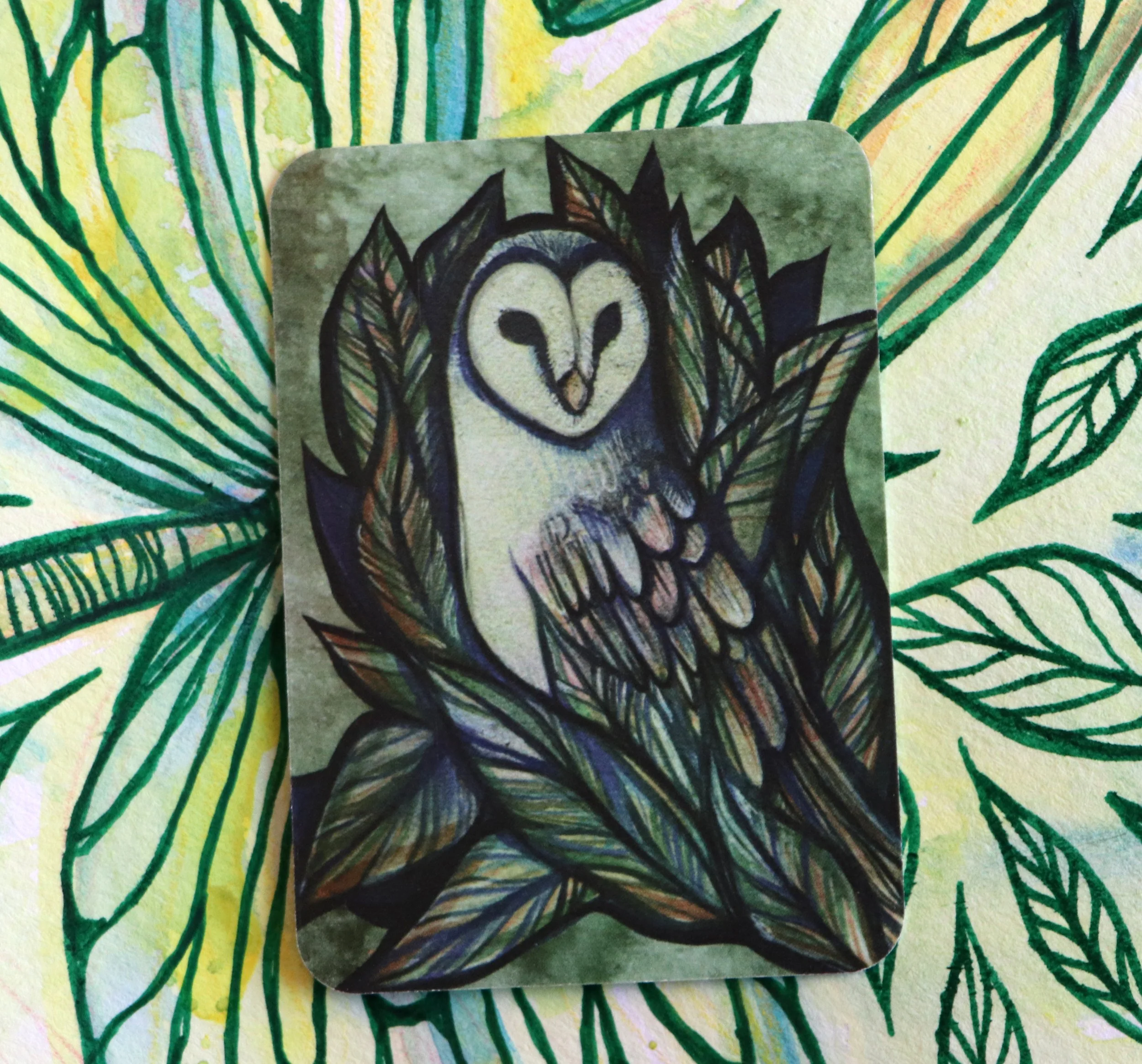
Of all owl species, the barn owl may carry the heaviest folklore. Its white, heart-shaped face, silent flight, and tendency to appear suddenly from dark spaces gave it a ghostly quality that frightened and fascinated people across European, African, and Middle Eastern traditions for centuries.
In British and Irish folk tradition, the barn owl was associated with death and was called the "ghost owl," "death owl," or "church owl" — the last because barn owls frequently roosted in old church towers and steeples, their eerie shrieks echoing through graveyards at night. To hear a barn owl screech near a sick person's window was to know the outcome. To see one in daylight was deeply unlucky.
And yet the barn owl also accumulated protective associations. In many rural communities, barn owls were welcomed and protected because they kept rodent populations down — and this practical value translated into a kind of reverence. A farm with a barn owl was a fortunate farm. The owl was both omen and guardian, simultaneously feared and honored.
In magical practice, the barn owl represents the ability to move between worlds — to be comfortable in the liminal space, to see what others cannot, to be the presence that others find uncanny. For witches who are themselves a little uncanny, who have always moved between worlds and never quite fit fully in either, the barn owl is a deeply resonant familiar.
🦉 The Barn Owl art throw pillow, Barn Owl art card, and Barn Owl art postcard celebrate that ghostly, gorgeous creature in full watercolor detail.
Owls Across World Mythologies
The owl's spiritual significance is not limited to the Western tradition. Across the world, cultures that had no contact with one another independently developed rich owl mythologies — which speaks to something universal in the human response to these birds.
In Native American traditions, owl symbolism varies significantly by nation and culture — it cannot be reduced to a single meaning. In some traditions, owls are associated with death and are considered ill omens. In others, they are wisdom figures, medicine animals, or messengers. The Hopi people have a burrowing owl as a god of the dead and of the underworld. The Cherokee tell stories of owls as transformed humans. It is important to approach the specific traditions of specific nations with respect and not collapse their distinct beliefs into a generic "Native American owl meaning."
In Hindu tradition, the owl is the vahana — the sacred vehicle or mount — of Lakshmi, goddess of wealth, fortune, and prosperity. An owl visiting your home in the Diwali season is considered an auspicious sign of Lakshmi's blessing. This is a beautiful counterpoint to the Western death-omen tradition: the same bird, in a different cultural context, heralds abundance rather than endings.
In ancient Mesopotamia, the great goddess Inanna/Ishtar was sometimes depicted with owls. An famous artifact known as the "Queen of the Night" relief, believed to depict either Inanna or Ereshkigal (goddess of the underworld), shows a beautiful winged figure flanked by owls — connecting the owl again to powerful feminine divine energy and the threshold between life and death.
In Japanese folklore, the owl (fukuro) is a symbol of good luck and protection against suffering and hardship. The word fukuro contains the characters for "luck" and "protection," making it a beloved talisman. Owl figures and charms are kept in homes and given as gifts to bring fortune.
🦉 The Owl Golden Moon poster brings that cross-cultural owl magic into your space — golden, luminous, and full of that ancient seeing energy.
The Owl as Familiar
In the Western witchcraft tradition, owls have been associated with witches' familiars for centuries — though in the historical record this association is less common than cats, dogs, or toads. Owls appear primarily in literary and artistic representations of witches rather than in actual trial records, which suggests the connection is more mythological than historical.
In modern practice, the owl familiar is worked with as a guide for those doing night work — shadow work, dream work, ancestral communication, or any magical practice that requires navigating darkness and uncertainty. The owl familiar helps you see in the dark. It helps you trust your night vision when you can't rely on the ordinary logic of daylight.
If you find yourself repeatedly drawn to owl imagery, if owls appear in your dreams, if you keep encountering them in unexpected places — this is worth paying attention to. In the animist worldview that underlies much of modern paganism, animals that keep appearing are communicating something. The owl who keeps finding you might be inviting you to develop your own capacity for seeing in the dark.
🏠 Welcome that energy to your home with the Purple Owl doormat or the Barn Owl art doormat — the owl at the threshold, guarding and welcoming in equal measure.
The Owl and the Moon
Owls are creatures of the night, and the night belongs to the moon. The overlap between owl symbolism and lunar symbolism in magical practice is deep and natural — both are associated with the unconscious, with hidden things, with the feminine divine, with cycles and mystery.
The full moon illuminates without the harshness of the sun — it reveals rather than exposes, softens rather than scorches. The owl moves through that same silvered light with perfect confidence. In meditation and visualization work, the owl and the moon together represent the capacity to see clearly by intuition rather than logic — to know things through feeling and perception rather than analysis.
The triple moon symbol — representing the Maiden, Mother, and Crone, the waxing, full, and waning phases — paired with the owl creates one of the most evocative combinations in modern pagan iconography. The owl who sees through all phases, who is as comfortable in the dark of the new moon as in the full moon's light, who turns to look at you with complete calm regardless of what you bring to the encounter.
🌕 The Triple Moon Owl car magnet, Triple Moon Owl holiday postcard, and the Owl Moon print all live in that beautiful intersection of owl and lunar magic.
Living with Owl Energy
You don't need to wait for a wild owl encounter to work with owl medicine. Surrounding yourself with owl imagery — intentionally chosen, placed with awareness — is a way of keeping that energy active in your daily life. A constant, gentle reminder to trust your night vision. To look at things from all angles. To be comfortable with what others find unsettling. To know that darkness is not the enemy of sight — it is the condition that makes a different kind of seeing possible.
Keep a Cute Owl rug underfoot as a daily reminder. Start your mornings with owl wisdom from an Owl Daisies latte mug. Carry your magical tools and everyday essentials in a Cute Owl tote bag. Wear the owl on a Cute Owl denim jacket that says, without words, exactly what kind of person you are.
For the little ones in your life — or the collector who never outgrew the joy of ornaments — the Cute Baby Owl ceramic ornament and Cute Baby Owl seat cushion bring that gentle, wide-eyed owl wonder into a space. The Owl You Need Is Love iPhone case keeps owl energy in your hand all day long — which, given the owl's associations with wisdom and clear seeing, seems like exactly the right place for it.
Put the Cute Owl sticker and Cute Owl square sticker on your laptop, water bottle, or Book of Shadows. Send a Barn Owl grocery bag into the world carrying your farmers market haul and your aesthetic simultaneously. And put your Green Barn Owl business card into the hands of people who need to know what you're about — because the owl on your card is saying something about you before you've said a word.
What the Owl Knows
There is a reason that across five thousand years of human spiritual life, across dozens of cultures and traditions that never spoke to one another, the owl keeps appearing in the same symbolic role. Wisdom. Sight. The ability to navigate darkness. The comfort with what others fear. The knowledge that the night is not empty — it is simply differently illuminated.
The owl doesn't need the sun to see. It has developed its own way of perceiving the world, calibrated for the hours when everything else goes quiet. That is not a limitation. That is a gift.
If you are a person who has always been more comfortable in the margins than the center, who sees things others miss, who does your best thinking when the world goes quiet — the owl has been your symbol for a long time. You just may not have known it yet.
🦉 Explore the original watercolor Owl print and the Owl Moon print — art made for people who know what it means to see in the dark.