ACEOs ATCs
Small enough to fit in your wallet. Powerful enough to build a global community.
There is something undeniably magical about a piece of original art you can hold in the palm of your hand. Not a print, not a reproduction — actual original artwork, made by an actual human being, small enough to slip into a card sleeve or tuck into your pocket. That's the world of ACEOs and ATCs, and once you fall into it, you never quite look at tiny things the same way again.
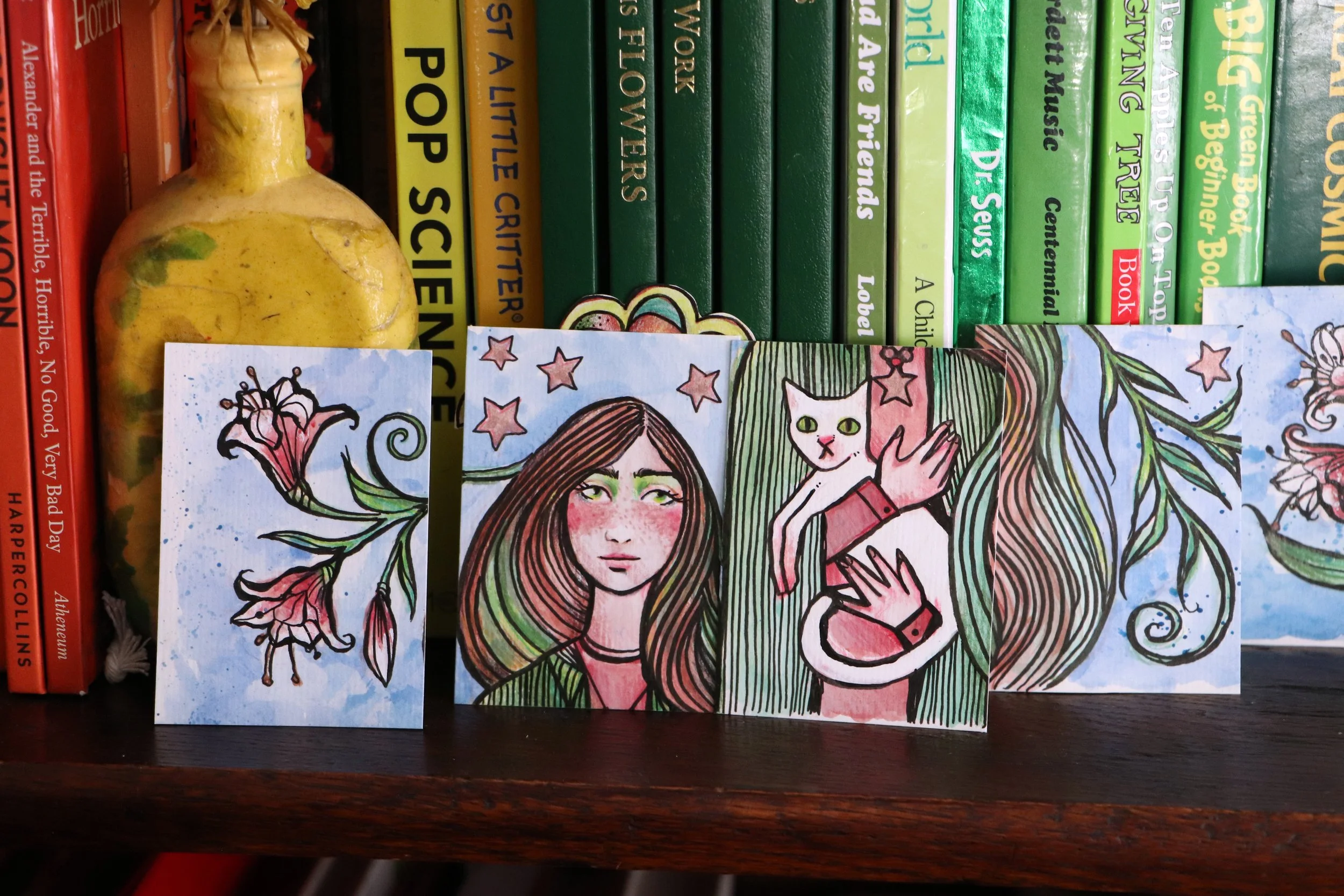
What Is an ATC?
ATC stands for Artist Trading Card. The format is simple and non-negotiable: 2.5 inches by 3.5 inches — exactly the size of a standard playing card or sports trading card. Within those dimensions, anything goes. Watercolor, ink, collage, photography, fiber art, miniature oil painting, stamping, mixed media. The only rule is the size.
But here's the part that makes ATCs truly special: they are not for sale. They are for trading. The entire premise of the ATC movement is that artists exchange their cards directly with other artists — hand to hand, or by mail — building collections and connections simultaneously. Money doesn't enter into it. The value is relational and artistic, not commercial.
The Origin of Artist Trading Cards
The ATC format was born in Zurich, Switzerland in 1997, created by Swiss artist M. Vänçi Stirnemann. He made a set of small cards and organized what he called a "trading session" — an event where artists could come together and swap their cards with one another. The rule was firm: cards could only be traded, never sold.
The idea spread with remarkable speed. Trading sessions began popping up in cities across Europe and North America. Artists who couldn't attend in person began mailing their cards to swap by post — a practice that came to be known as a "mail trade." Online communities formed around the format in the early 2000s, and suddenly a Swiss artist's simple idea had become a global grassroots movement connecting thousands of artists across every medium and skill level.
What made ATCs catch on so quickly was their radical accessibility. You didn't need to be a professional. You didn't need expensive supplies or a gallery showing. You needed a small piece of paper and the willingness to make something with your hands. Beginners traded alongside masters. The playing field was leveled by the size of the card.
Enter the ACEO
As ATCs gained popularity, a natural question arose: what about people who wanted to collect this tiny art but weren't artists themselves? The trading-only rule of ATCs meant non-artists were left out of the joy of owning these miniature works.
The answer was the ACEO — Art Cards, Editions and Originals. ACEOs follow the exact same format as ATCs — 2.5 by 3.5 inches — but they can be bought and sold. The name reflects the two types: original one-of-a-kind pieces, and limited edition prints of original works.
ACEOs exploded in the early-to-mid 2000s alongside the rise of online marketplaces like eBay, where they became one of the most searched art categories. Collectors who had never thought of themselves as art collectors suddenly found themselves building libraries of tiny originals — affordable, displayable, and deeply personal in a way that larger art sometimes isn't.
The ACEO format democratized art collecting the same way ATCs had democratized art making. You didn't need a large wall or a large budget. You needed appreciation, and a card sleeve.
Why Tiny Art Matters
It might seem counterintuitive — in a culture that often equates size with significance, why would small art carry such weight?
Part of it is intimacy. A 2.5 by 3.5 inch painting requires you to lean in, to look closely, to notice details that a larger work might render obvious. There is a different kind of skill involved in miniature work — the artist must make every brushstroke count, every square centimeter earn its place. The constraints of the format push creativity in unexpected directions.
Part of it is accessibility, for both maker and collector. An ACEO original might cost a fraction of what the same artist's larger work commands, making it possible to own genuine original art at almost any budget. For artists, the small format is perfect for experimentation — trying a new style, a new medium, a new subject — without the pressure of committing to a full-size piece.
And part of it is simply the delight of the thing. There is something joyful and a little wondrous about a complete, fully realized work of art that fits in your wallet.
ACEOs & ATCs in the Watercolor World
Watercolor is perhaps the most natural medium for the ACEO and ATC format. The medium's transparency, its layering, its ability to render both loose impressionistic washes and precise botanical detail — all of it translates beautifully to a small surface. Watercolor ACEOs have a luminosity and softness that feels particularly suited to intimate, hand-held viewing.
For artists who work in watercolor, ACEOs offer a wonderful way to explore subjects that might feel too small or too specific for a full painting — a single wildflower, a pair of wings, a patch of moss, a tiny portrait. The limitations become liberating.
🎨 Browse original watercolor ACEOs in the shop — each one a tiny original, made by hand, ready to collect or gift.
Collecting ACEOs: Where to Start
If you're new to collecting ACEOs, the entry point is wonderfully low-pressure. Here's what to know:
Size is standard. Every ACEO, regardless of artist or medium, is 2.5 by 3.5 inches. This means they can all be stored and displayed the same way — in trading card sleeves, binders, or small frames made for the format.
Originals vs. prints. Original ACEOs are one-of-a-kind — the actual painted or drawn surface, not a reproduction. Edition ACEOs are small-run prints of an original work. Both are legitimate, and both have their place in a collection. Originals tend to command higher prices; prints make beloved works more accessible.
Display options. ACEOs look beautiful displayed in trading card pages in a binder, framed in small shadowbox frames, propped on tiny easels on a shelf, or tucked into the pages of a journal or sketchbook. Some collectors build elaborate gallery walls of miniatures. Others keep them private — a personal collection to flip through like a deck of illustrated cards.
What to collect. The same advice applies to ACEOs as to any art: collect what genuinely moves you. Subject matter, medium, color palette, artist style — follow your eye and your gut. A collection of ACEOs built over time becomes a deeply personal thing, a record of what you found beautiful across years and moods and seasons.
Trading ATCs: The Community Side
If you're an artist, the ATC trading world is worth exploring. Trading sessions — both in-person and online — are organized through social media groups, art forums, and local art communities. The basic format is the same everywhere: artists make cards, artists swap cards, no money changes hands.
Mail trades are particularly popular and wonderfully old-fashioned in the best way — you make a card, seal it in an envelope, send it to someone you may never meet, and receive something handmade in return. There is a pen-pal quality to it that feels increasingly rare and precious.
Many artists keep dedicated sketchbooks or binders to document their trades — noting who they traded with, where that person lives, what the card depicts. Over time, an ATC collection becomes a kind of illustrated address book of the global art community.
The Enduring Appeal
More than two decades after M. Vänçi Stirnemann organized that first trading session in Zurich, the ACEO and ATC world is still thriving. New artists discover the format every day. Collections grow. Trades happen across time zones and language barriers. Tiny paintings travel the world in standard envelopes.
In an age of digital everything — digital art, digital collecting, digital connection — there is something quietly radical about a physical object this small, this handmade, this human. You can hold it. You can feel the texture of the paper, the slight raised surface of dried paint. It was made by a person's hands and now it's in yours.
That, at the end of the day, is what ACEOs and ATCs are really about. Not the format, not the dimensions, not the market. The connection between the person who made something and the person who receives it.
🖼️ Shop original watercolor ACEOs and ATCs — tiny originals made with a whole lot of heart.
Ready to Start Your Collection?
Whether you're drawn to the intimacy of miniature originals, the accessibility of the format, or simply the delight of owning something handmade and one-of-a-kind, ACEOs and ATCs are one of the most joyful corners of the art world to explore.
Start small. Follow your eye. And remember — the best collection is simply the one that makes you happy every time you look at it.